How eDoctrina Applied AI in Real Classrooms
eDoctrina worked with Itera Research to turn handwritten student work into reliable, structured data without forcing schools to abandon paper exams.
Problem
In many K–12 schools, handwritten assessments remain a central part of daily teaching, even as digital tools become more common. Teachers rely on paper tests because they fit classroom routines, testing policies, and student needs, yet those same tests create a heavy grading and data-entry burden once the lesson ends.
Hours are spent reviewing answers, transferring results into systems, and double-checking entries before reports can be shared.
As eDoctrina expanded across districts, this pressure became more visible. Teachers were handling growing volumes of assessments, while administrators expected faster turnaround and cleaner data for reporting and analysis.
Generic OCR tools were often tested as a shortcut, yet they struggled in practice. Student handwriting varied widely, answer layouts changed between tests, and scan quality depended on classroom copiers rather than specialized hardware.
The result was a gap between what schools needed and what existing technology could deliver. Fully digital exams were not always an option, and manual transcription could not scale.
Without a reliable way to process handwritten assessments, the platform risked shifting work back onto teachers instead of reducing it.
Where the AI Fits Inside eDoctrina
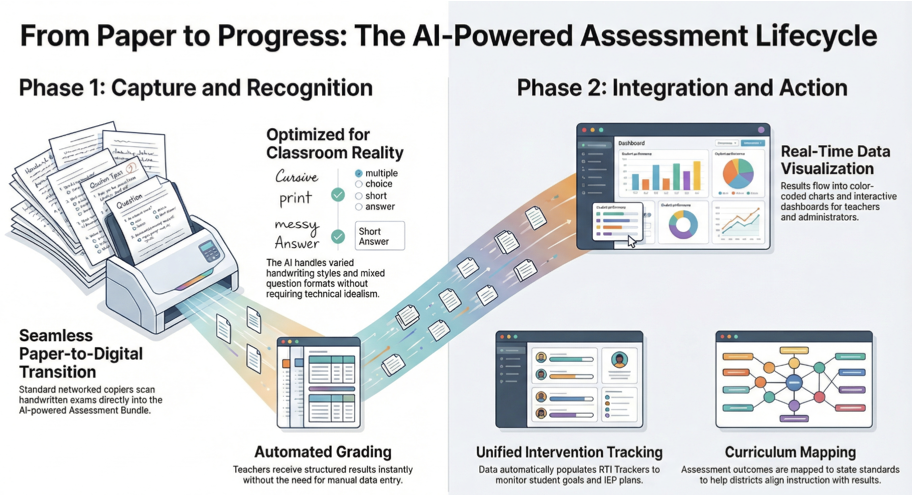
When Itera Research worked with eDoctrina on handwriting recognition, the starting point was classroom reality rather than technical idealism. The system needed to work with paper forms, standard copiers, and imperfect inputs, since those constraints defined everyday school operations.
We designed handwriting recognition specifically for education use cases. The solution handled varied handwriting styles, mixed question formats, and scanned paper forms produced by networked copiers already present in schools.
Assessment creation and grading
The Assessment Bundle uses AI-powered handwriting recognition to process paper-based exams scanned through standard networked copiers. Teachers can create assessments aligned with state standards, collect handwritten responses, and receive structured results without manual transcription. This supports faster grading while preserving paper exams where they remain necessary.
Data reporting
Recognized assessment results flow directly into eDoctrina’s reporting system, which is often treated as the platform’s core. Educators can work with interactive visualizations, color-coded charts, and real-time reports that update as new data is processed. Teachers select student groups and tests through a clear dashboard, while administrators view aggregated results at school or district level.
RTI and student tracking
Handwritten assessment data feeds into the RTI Tracker, where individual student goals, IEPs, and intervention plans are monitored in one place. This allows educators to connect assessment outcomes with intervention planning without duplicating work or switching tools.
Curriculum alignment
Assessment results processed through AI recognition can be mapped back to curriculum standards inside the Curriculum Module. Automated scope and sequence reports, unit plans, and standards tracking help districts align instruction with measurable outcomes, using data generated directly from classroom assessments.
Broader instructional tools
The same data foundation supports virtual lesson plans, LMS functionality through the SOLe module, educator observation workflows via OBSeRVE, and educator effectiveness evaluations. Handwritten assessment data becomes one input among many, rather than an isolated artifact.
Technologies and components
- Machine learning models for handwritten text recognition, trained on real student handwriting samples
- Image preprocessing pipelines optimized for copier and scanner output
- Custom assessment parsing logic for mixed layouts and question formats
- Integration with eDoctrina’s assessment and reporting modules
- Cloud infrastructure hosted on AWS, using EC2 with auto scaling and load balancing
- CI/CD pipelines for continuous refinement and safe rollout during the school year
- Backend services built in PHP and Java
- Frontend components using HTML5, CSS3, and JavaScript
Results at Scale
As handwriting recognition became part of eDoctrina’s assessment workflow, its impact showed up across the wider platform, not only in individual classrooms.
Today, eDoctrina supports over 1 million users, including teachers, administrators, and students, and is actively used across more than 20 U.S. states and over 1,000 districts.
The platform is deployed in 5,000+ schools, where it processes assessments, reporting, and instructional planning as part of everyday operations.
For schools using AI-powered assessment workflows, handwritten tests no longer created a bottleneck between instruction and reporting. Grading cycles shortened, manual data entry dropped, and assessment results became available earlier in the reporting chain, which helped districts act on data while it was still relevant. This scale confirmed that handwriting recognition was not an isolated feature, but a dependable component inside a system built for long-term institutional use.
Bigger Picture
For Itera Research, this work reinforced the importance of designing AI around real constraints rather than abstract benchmarks. Applied carefully, AI can reduce workload and improve clarity without disrupting established processes, especially in institutional settings like education where stability matters.
If you are building AI systems that need to work with imperfect data and real-world constraints, we should talk. Itera Research helps teams apply AI where it delivers practical value, not just technical demonstrations, and build solutions that hold up under everyday use.
Want to now more?
Check all parts of this amazing case by eDoctrina
Discover more cases here
Real challenges. Custom solutions. Discover how Itera Research builds the software that powers industry leaders worldwide.