Managing School Assessment Demand the Smarter Way with eDoctrina
Growth in education rarely arrives quietly. More students, more assessments, more reporting—yet the same number of people expected to carry it all forward. This case shows how eDoctrina and Itera Research reshaped that equation, moving scale from human effort into system design so schools could expand calmly, without adding operational weight.
Problem
As eDoctrina adoption expanded across U.S. schools, growth brought a familiar operational tension. Assessment volumes increased, reporting requirements became more frequent, and instructional programs relied on data in more places than before. Staffing levels, however, remained largely fixed, shaped by budgets, hiring cycles, and long-term contracts that rarely move at the pace of software adoption.
Teachers felt this pressure first. More assessments meant more grading, more data entry, and more follow-up work tied to reporting and intervention planning. Administrative teams faced similar strain as data moved between classrooms, schools, and districts through a mix of systems and manual steps. Each additional school added complexity that accumulated quietly over time.
Traditional responses offered limited relief. Some schools reduced assessment depth to keep workloads manageable. Others accepted longer reporting cycles or added temporary support during peak periods. These approaches helped in the short term, yet they did not address the underlying issue. As usage grew, effort scaled alongside it.
For eDoctrina, this created a clear risk. Continued growth depended on a platform that could absorb increased activity without pushing additional operational work onto educators and administrators. Scaling needed to happen inside the system itself, rather than through expanded staffing or parallel processes.
Build
When Itera Research worked with eDoctrina on this challenge, the focus shifted to consolidation and flow. The platform needed to treat assessment, reporting, and follow-up work as parts of a single operational cycle rather than separate responsibilities handled by different teams and tools.
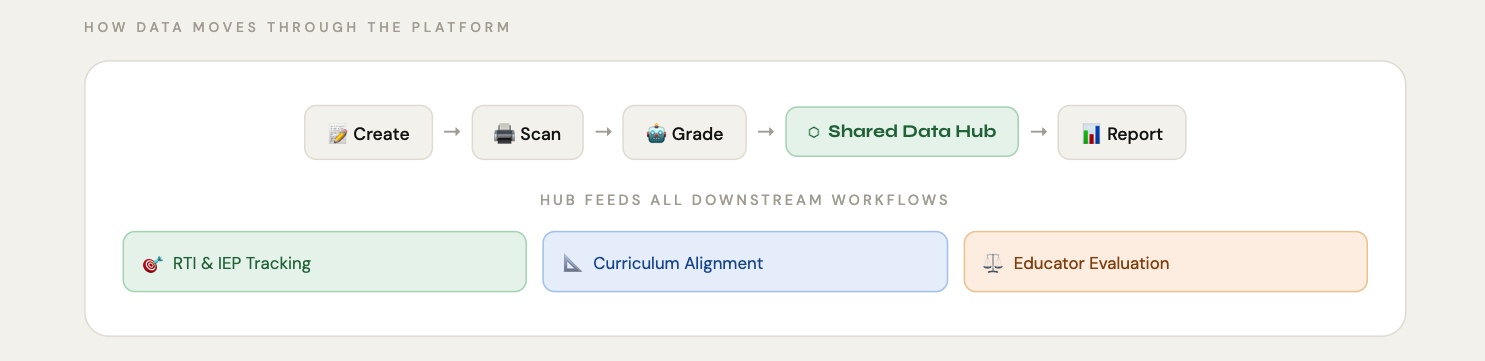
Workflows were designed to reduce repeated handling of the same information. Assessment creation, checking, aggregation, and reporting were connected so data moved forward automatically once student work was submitted. Teachers retained control over instructional decisions, while the system handled routine processing that previously consumed time across roles.
Paper-based and digital inputs were supported within the same framework. Schools continued to use established assessment formats and existing equipment, while the platform absorbed the operational complexity behind the scenes. This approach allowed schools to scale usage without retraining staff or restructuring daily routines.
Rollout followed the rhythm of the school year. Changes were introduced incrementally and refined through live use, which kept operations predictable during periods when stability mattered most. Growth occurred through reinforcement of existing workflows rather than disruption.
Tools & Technologies
|
|
Key Features
Several platform capabilities directly supported scale under fixed staffing conditions. Each feature reduced marginal effort as usage increased, which allowed scale to remain manageable.
- Integrated assessment workflows that connect creation, grading, and reporting inside one system
- Automated grading and aggregation that reduce repetitive handling of assessment data
- Real-time reporting dashboards that update as assessments are processed
- District-ready reporting views that reduce follow-up coordination between schools and central teams
- Shared data foundation that supports RTI tracking, curriculum alignment, and educator evaluation without duplicate entry
- Hardware-aware design that uses existing copiers and devices already present in schools
Outcome
As these workflows became part of daily operations, growth no longer translated into proportional increases in effort. Schools expanded assessment coverage and reporting frequency while keeping administrative load steady. Teachers spent less time on repetitive processing and more time on instruction and review.
Administrators gained earlier access to structured data, which simplified reporting cycles and reduced manual reconciliation across teams. At district level, consistency improved as schools followed the same operational flow, even as participation grew.
Today, eDoctrina supports over one million users and is used across more than 20 states, over 1,000 districts, and more than 5,000 schools. This scale was reached without corresponding growth in administrative overhead, which confirmed that capacity had shifted from people to platform.
Bigger Picture
This case highlights a broader principle in education technology. Sustainable scale depends on systems that reduce marginal work as usage grows. When workflows are connected end to end and supported by shared data structures, institutions can expand calmly rather than reactively.
For Itera Research, the work with eDoctrina reinforced the value of designing for scale as an operational constraint from the start. In education, long-term success comes from platforms that allow institutions to grow steadily, even as expectations increase year after year.
If you are responsible for scaling an education platform or managing operations across multiple schools, we should talk. Itera Research works with teams that design systems to absorb growth through structure and automation, while keeping staff workload predictable and sustainable over time.
Discover more cases here
At Itera Research, we don’t just build software; we engineer competitive advantages. Our portfolio spans from AI-driven automation that slashes operational costs to life-saving MedTech wearables. Every case is a testament to how we bridge the gap between complex technical challenges and real-world scalability.